EN FRANCAIS CI-DESSOUS
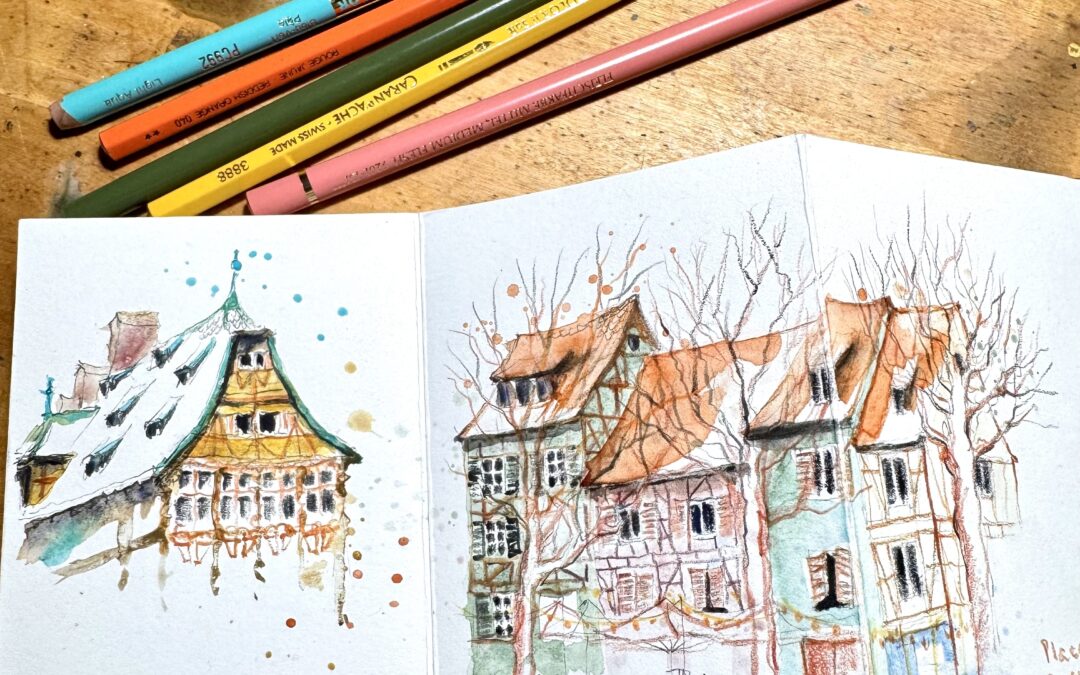
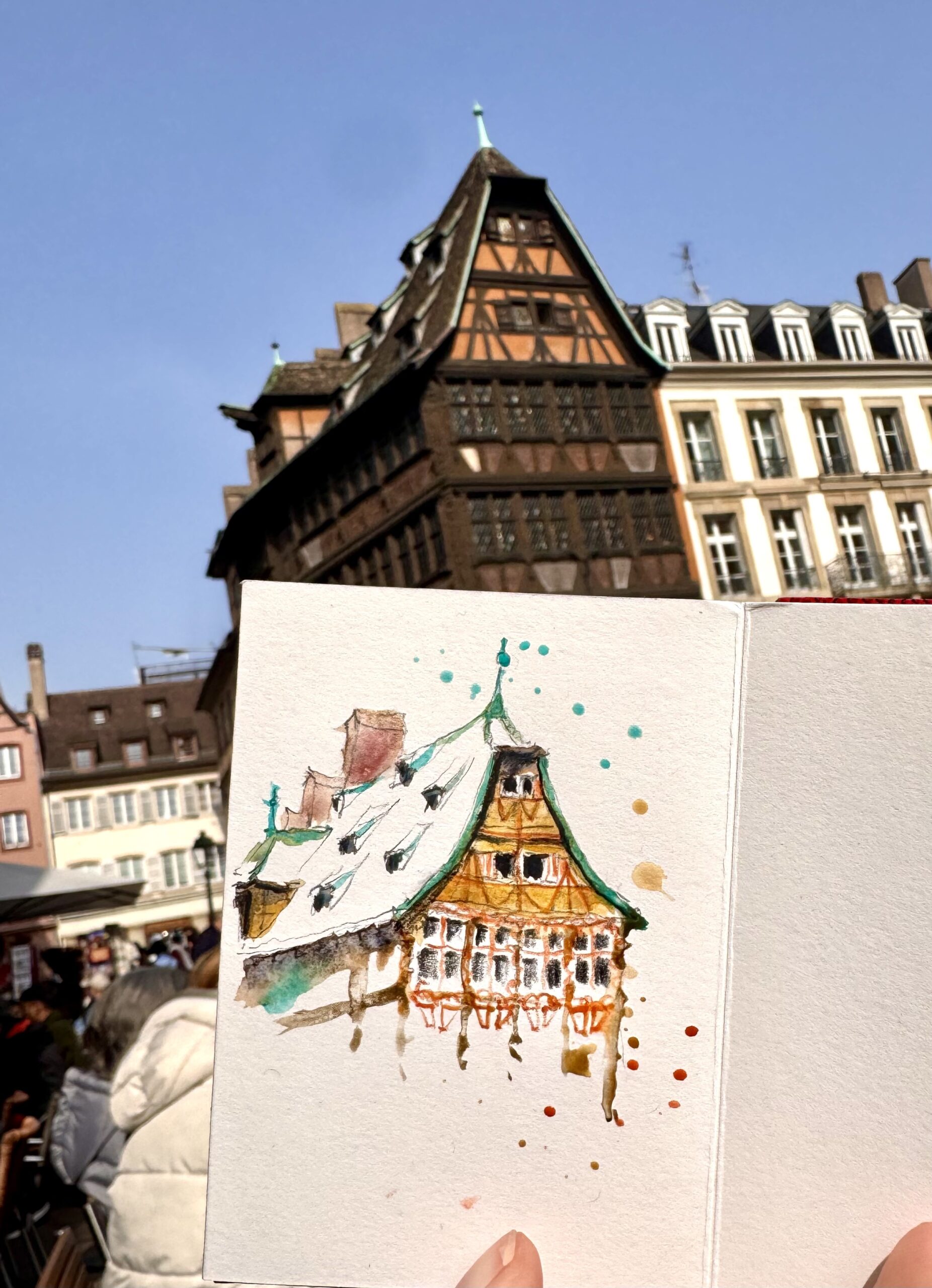
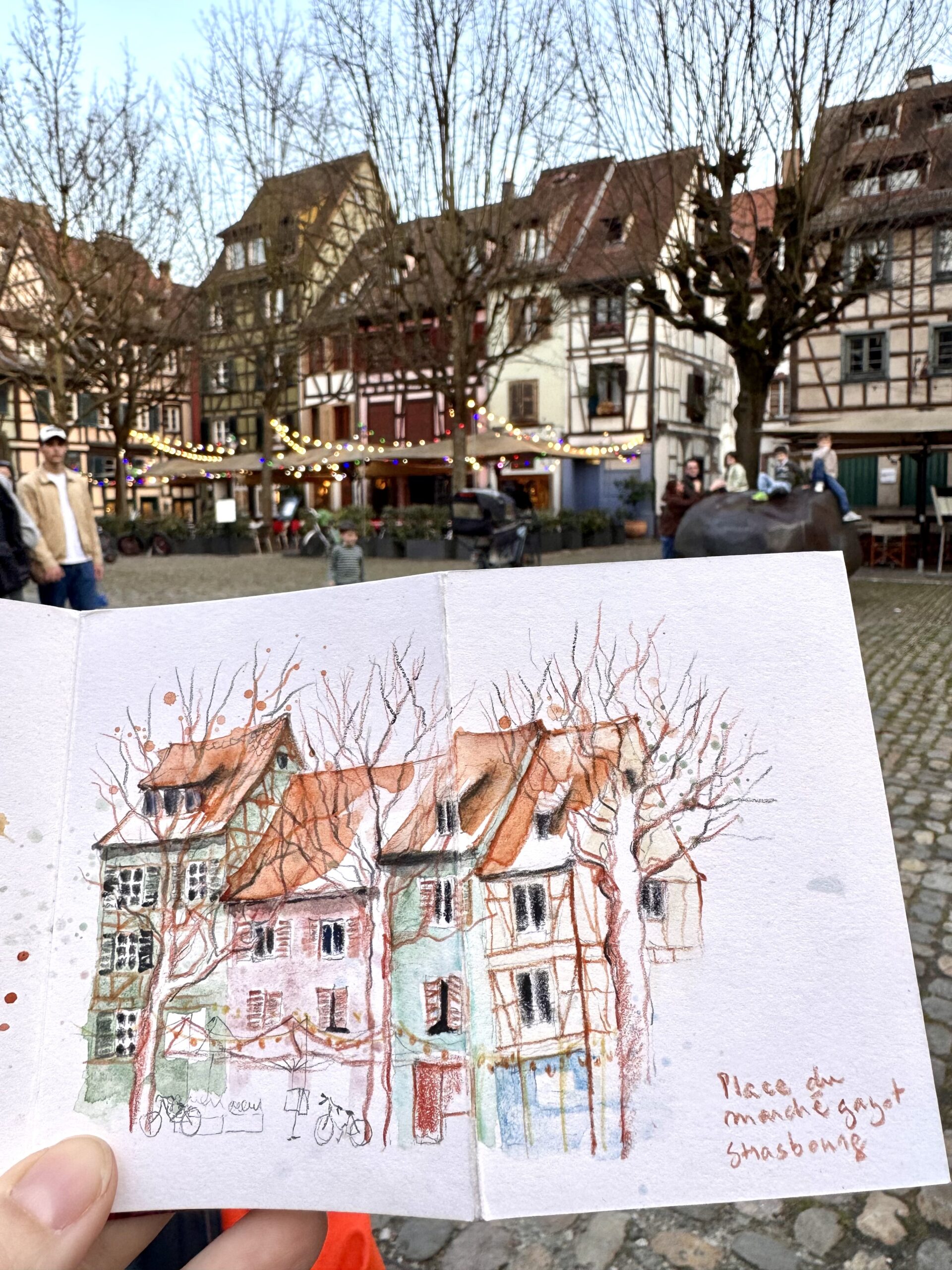
Last weekend I was hunched over a tiny sketchbook in Strasbourg, happily drawing wonky buildings while my (very patient, non-sketching) friends waited. As my pen zigzagged across the page, completely ignoring the rules of perspective I spent years learning as an architect, I started thinking:
Why does sketching feel so free — while realistic observational drawing can feel like homework?
The answer has transformed how I teach drawing and how I create art. Let me break it down for you.
Sketching vs. Observational Drawing: What’s the Real Difference?
At its core, the difference comes down to this:
Observational drawing tries to describe reality as accurately as possible — every window, every shadow, every proportion.
Sketching interprets reality. It’s a personal response to what you see, filtered through your eye, your hand, your mood, and your favourite colours.
One is a document. The other is a conversation.
Neither is better. But for urban sketching — out in the field, in public, often on the move — sketching gives you a freedom that pure observational drawing rarely does.
Why Perspective Rules Kill Sketching Joy
I see this constantly with my architecture students. They freeze in front of a building, paralysed by questions: How many windows does it have? Is that vanishing point right? Did I get the scale correct?
That mindset made perfect sense when they were drafting projects or a drawing exam. But it kills the joy of sketching. It takes you to the Left (rational side) of your brain!
Three teachers helped me escape that trap: Ch’ng Kiah Kiean, Ian Fennelly and Betty Edwards. Their shared insight was simple but radical:
“Just look at what direction the lines are going. Stop counting the windows. Splash colour and move on.”
That’s the sketching mindset in a nutshell.
How to Develop Your Own Sketching Style (And Why Colour is Your Secret Weapon)
Your sketching style is made of two things: your linework and your colours. Think of it like your handwriting — totally unique to you, even if you’re drawing the same street as someone standing right beside you.
Here’s how I approach it:
- I draw what I find beautiful or interesting, not everything that’s there. A complicated facade? I simplify it. A dull corner? I leave it out.
- I use my favourite colours, even if they’re not ‘accurate’. If the building is grey but I love warm ochres and dusty pinks, I’ll use them anyway. It’s my sketch, not a photograph.
- I look at my palette first. If I don’t see my favourite colours in the scene in front of me, I just… add them where I like.
This personalisation is what makes a sketch feel alive rather than just correct.
Breaking Your Own Habits: How to Keep Your Sketching Practice Fresh
Even experienced sketchers can fall into routines — the same tools, the same compositions, the same process every time. I deliberately break my own habits by layering materials:
- Colour pencil over watercolour for texture and depth
- Wax crayons for bold, waxy marks that resist watercolour washes
- Gouache for opaque highlights on top of dark washes
- Water-soluble graphite for soft, smoky line work
- graphite and color pencil for branches of vegetation
There’s no correct combination. Add whatever you’re curious about. Your sketchbook is a place to experiment, not to perform.
The Permission Slip You Didn’t Know You Needed
If you’ve been holding back from sketching because you can’t draw ‘properly’ — this is your permission slip.
Sketching isn’t about copying reality. It’s about creating
your own version of it.
The wonky buildings in Strasbourg? They’re more ‘me’ than any precisely measured architectural drawing I could have made.
That’s the whole point.
Over to You
Are you more drawn to sketching freely, or do you prefer the precision of observational drawing? Have you ever tried mixing the two? Tell me in the comments — I’d love to hear where you are in your drawing journey.
FR
Le croquis versus le dessin d’observation réaliste
Le week-end dernier, j’étais penchée sur un tout petit carnet de croquis à Strasbourg, dessinant joyeusement des bâtiments bancals pendant que mes amis (très patients, et non-croqueurs) attendaient. Tandis que mon stylo zigzaguait sur la page, ignorant allègrement les règles de perspective que j’ai mis des années à apprendre en tant qu’architecte, j’ai commencé à me demander :
Pourquoi le croquis procure-t-il une telle liberté — alors que le dessin d’observation réaliste peut ressembler à des devoirs ?
La réponse a transformé ma façon d’enseigner le dessin et de créer. Laissez-moi vous l’expliquer.
Croquis vs. dessin d’observation : quelle est la vraie différence ?
Au fond, la différence tient à ceci :
Le dessin d’observation cherche à décrire la réalité aussi fidèlement que possible — chaque fenêtre, chaque ombre, chaque proportion.
Le croquis, lui, interprète la réalité. C’est une réponse personnelle à ce que vous voyez, filtrée par votre œil, votre main, votre humeur et vos couleurs préférées.
L’un est un document. L’autre est une conversation.
Ni l’un ni l’autre n’est supérieur. Mais pour le carnet de voyage urbain — sur le terrain, en public, souvent en mouvement — le croquis offre une liberté que le dessin d’observation pur accorde rarement.
Pourquoi les règles de perspective tuent la joie du croquis
Je le vois constamment chez mes étudiants en architecture. Ils se figent devant un bâtiment, paralysés par les questions : Combien de fenêtres y a-t-il ? Est-ce que ce point de fuite est correct ? Est-ce que j’ai bien respecté les proportions ?
Cet état d’esprit avait tout son sens lorsqu’ils travaillaient sur des projets ou passaient des examens de dessin. Mais il tue la joie du croquis. Il vous emmène vers le côté gauche (rationnel) de votre cerveau !
Trois enseignants m’ont aidée à échapper à ce piège : Ch’ng Kiah Kiean, Ian Fennelly et Betty Edwards. Leur intuition commune était simple, mais radicale :
« Regardez simplement dans quelle direction vont les lignes. Arrêtez de compter les fenêtres. Éclaboussez de la couleur et avancez. »
C’est l’état d’esprit du croquis en quelques mots.
Comment développer votre propre style (et pourquoi la couleur est votre arme secrète)
Votre style de croquis se compose de deux éléments : votre trait et vos couleurs. Pensez-y comme à votre écriture — totalement unique, même si vous dessinez la même rue que quelqu’un debout juste à côté de vous.
Voici comment je procède :
- Je dessine ce que je trouve beau ou intéressant, pas tout ce qui est là. Une façade complexe ? Je la simplifie. Un coin sans intérêt ? Je l’omets.
- J’utilise mes couleurs préférées, même si elles ne sont pas « fidèles ». Si le bâtiment est gris mais que j’aime les ocres chauds et les roses poussiéreux, je les utilise quand même. C’est mon croquis, pas une photographie.
- Je regarde d’abord ma palette. Si je ne retrouve pas mes couleurs préférées dans la scène devant moi, je les ajoute simplement… là où ça me plaît.
C’est cette personnalisation qui donne à un croquis un sentiment de vie plutôt que de simple exactitude.
Casser ses propres habitudes : comment garder sa pratique du croquis fraîche
Même les croqueurs expérimentés peuvent tomber dans des routines — les mêmes outils, les mêmes compositions, le même processus à chaque fois. Je brise délibérément mes propres habitudes en superposant les matériaux :
- Crayon de couleur sur aquarelle pour la texture et la profondeur
- Crayons à la cire pour des traces grasses et audacieuses qui repoussent les lavis d’aquarelle
- Gouache pour des rehauts opaques sur des lavis sombres
- Graphite hydrosoluble pour un trait doux et fumeux
- Graphite et crayon de couleur pour les branches de végétation
Il n’existe pas de combinaison correcte. Ajoutez ce qui vous intrigue. Votre carnet de croquis est un espace d’expérimentation, pas de performance.
Le bon de permission que vous ne saviez pas avoir besoin
Si vous vous retenez de croquer parce que vous ne savez pas dessiner « correctement » — voici votre bon de permission.
Le croquis ne consiste pas à copier la réalité. Il consiste à créer votre propre version de celle-ci.
Les bâtiments bancals de Strasbourg ? Ils sont bien plus « moi » que n’importe quel dessin architectural précisément mesuré que j’aurais pu faire.
C’est tout l’intérêt.
À vous de jouer
Êtes-vous plutôt attirée par le croquis libre, ou préférez-vous la précision du dessin d’observation ? Avez-vous déjà essayé de mélanger les deux ? Dites-le-moi en commentaires — j’adorerais savoir où vous en êtes dans votre parcours de dessin.
my tiny sketchbook is made in Portugal and it has the most FANTASTIC paper!!!
You can buy it here: https://inusitado.pt/collections/leporellos
This is such a brilliant post and a welcome reminder of the direction I am striving to go with my art and sketching… I am still in the rut of trying to capture the “perfection” of what I see, rather than making “art” and having fun.
Your art is lovely and uplifting. Thank you for sharing it with us!
Thank you Cindy !
I have been trying to get over “perfectionitis”, where I become hyper-critical of everything I draw and paint, look at it in disgust and stop for a few days or even weeks. I live in Venice now and I decided to just go out and draw what I see, then come home and paint it. It’s too cold right now to do plein air painting, so I go out with my small sketchbook and pencils, draw a canal scene, come back and try to paint it.
I love painting and drawing and I took one of your online classes. But I really struggle with trying to get the buildings along the canal right, especially with perspective. I never went to art or architecture school, so I can’t draw perfectly in perspective.
I like your approach. The more I draw the better it gets.
Thank you Esme!
How lucky you are to live in Venice!
Just look in what direction the lines are going! Don’t worry about perspective 😉